Ssrs Image Rendering Pdf
- Export SSRS report directly to PDF or Excel Format(without Report Viewer) In this post, we are explaining how SSRS report can be directly exported to PDF or Excel. Show PDF report accepts 3 parameters, report is the name of the report on the report server, reportParameters is the parameter required for the report to run, fileName is the name in.
- 2017-5-19 Rendering a Report containing JPEG or PNG to PDF – Learn more on the SQLServerCentral forums. So despite the sizing being wrong, the image actually is rendering at a higher quality.
- Export Reports (Report Builder and SSRS); 11 minutes to read +3; In this article. You can export a Reporting Services report to another file format, such as PowerPoint, Image, PDF, Microsoft Word, or Microsoft Excel or export the report by generating an Atom service document, listing the Atom-compliant data feeds available from the report.
The PDF rendering extension renders Reporting Services paginated reports to files that can be opened in Adobe Acrobat and other third-party PDF viewers that support PDF 1.3. Although PDF 1.3 is compatible with Adobe Acrobat 4.0 and later versions, Reporting Services supports Adobe Acrobat 11.0 or later. The rendering extension does not require Adobe software to render the report. However, PDF viewers such as Adobe Acrobat are required to view or print a report in PDF format.
The PDF rendering extension supports ANSI characters and can translate Unicode characters from Japanese, Korean, Traditional Chinese, Simplified Chinese, Cyrillic, Hebrew, and Arabic with certain limitations. For more information about the limitations, see Export Reports (Report Builder and SSRS).
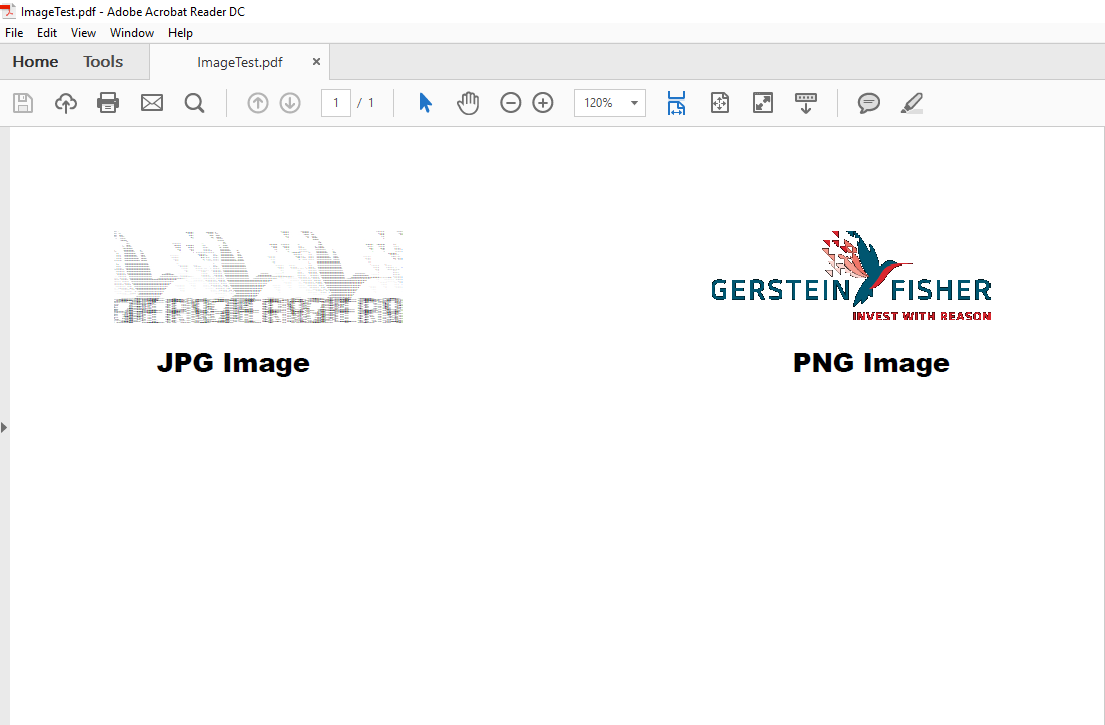
I have an SSRS report that displays an image that is sourced externally via a file path. On preview, the report and image looks fine. But when I 'export to PDF', the image on the report is not rendered properly. It looks all blurred with black dots and lines. Hi, I'm having an issue with an image in an SSRS report. It's a.PNG, 300dpi, 185 x 58. When I run the report through VS, it renders fine. The image object in the report is set to render at original size, so that all is fine. The problem arises when I save as PDF, everything goes all grainy and the colours also seem weird.
The PDF renderer is a physical page renderer and, therefore, has pagination behavior that differs from other renderers such as HTML and Excel. This topic provides PDF renderer-specific information and describes exceptions to the rules.
Note
You can create and modify paginated report definition (.rdl) files in Report Builder and in Report Designer in SQL Server Data Tools. Each authoring environment provides different ways to create, open, and save reports and related items.
Font Embedding
When possible, the PDF rendering extension embeds the subset of each font that is needed to display the report in the PDF file. Fonts that are used in the report must be installed on the report server. When the report server generates a report in PDF format, it uses the information stored in the font referenced by the report to create character mappings within the PDF file. If the referenced font is not installed on the report server, the resulting PDF file might not contain the correct mappings and might not display correctly when viewed.
Fonts are embedded in the PDF file when the following conditions apply:
Oct 03, 2019 Hello from Steve I have two Fonts '12.5' and '13' I only want it to find 'Font 13 please Sub NewYorkJazz With Selection.Find.Font.Size = 13.Bold = True End With stringReplaced = stringReplaced + Word 2010 Fonts. Fonts for microsoft word 2010. Beside that, we will found another Microsoft Word 2010 Fonts Download collection, such as microsoft word 2013 fonts, microsoft office fonts list and cool fonts on microsoft word. You could customize as well, change the details and make our corrections.
Font embedding privileges are granted by the font author. Installed fonts include a property that indicates whether the font author intends to allow embedding a font in a document. If the property value is EMBED_NOEMBEDDING, the font is not embedded in the PDF file. For more information, see 'TTGetEmbeddingType' on msdn.microsoft.com.
The Font is TrueType.
Fonts are referenced by visible items in a report. If a font is referenced by an item that has the Hidden property set to True, the font is not needed to display rendered data and will not be included in the file. Fonts are embedded only when they are needed to display the rendered report data.

If all of these conditions are met for a font, the font is embedded in the PDF file. If one or more of these conditions is not met, the font is not embedded in the PDF file.
Note
Although the conditions are met, there is one circumstance under which fonts are not embedded in the PDF file. If the fonts used are the ones in the PDF specification that are commonly known as standard type 1 fonts or the base fourteen fonts, then fonts are not embedded for ANSI content.
Fonts on the Client Computer
When a font is embedded in the PDF file, the computer that is used to view the report (the client computer) does not need to have the font installed for the report to display correctly.
When a font is not embedded in the PDF file, the client computer must have the correct font installed for the report to display correctly. If the font is not installed on the client computer, the PDF file displays a question mark character (?) for unsupported characters.
Verifying Fonts in a PDF File
Differences in PDF output occur most often when a font that does not support non-Latin characters is used in a report and then non-Latin characters are added to the report. You should test the PDF rendering output on both the report server and the client computers to verify that the report renders correctly.
Do not rely on viewing the report in Preview or exporting to HTML because the report will look correct due to automatic font substitution performed by the graphical design interface or by Microsoft Internet Explorer, respectively. If there are Unicode Glyphs missing on the server, you may see characters replaced with a question mark (?). If there is a font missing on the client, you may see characters replaced with boxes (□).
The fonts that are embedded in the PDF file are included in the Fonts property that is saved with the file, as metadata.
Metadata
In addition to the report layout, the PDF rendering extension writes the following metadata to the PDF Document Information Dictionary.
| PDF property | Created from |
|---|---|
| Title | The Name attribute of the Report RDL element. |
| Author | The Author RDL element. |
| Subject | The Description RDL element. |
| Creator | Reporting Services product name and version. |
| Producer | Rendering extension name and version. |
| CreationDate | Report execution time in PDF datetime format. |
Interactivity
Some interactive elements are supported in PDF. The following is a description of specific behaviors.
Show and Hide
Dynamic show and hide elements are not supported in PDF. The PDF document is rendered to match the current state of any items in the report. For example, if the item is displayed when the report is run initially, then the item is rendered. Images that can be toggled are not rendered, if they are hidden when the report is exported.
Document Map
If there are any document map labels present in the report, a document outline is added to the PDF file. Each document map label appears as an entry in the document outline in the order that it appears in the report. In Acrobat, a target bookmark is added to the document outline only if the page it is on is rendered.
If only a single page is rendered, no document outline is added. The document map is arranged hierarchically to reflect the level of nesting in the report. The document outline is accessible in Acrobat under the Bookmarks tab. Clicking an entry within the document outline causes the document to go to the bookmarked location.
Bookmarks
Bookmarks are not supported in PDF rendering.
Drillthrough Links
Drillthrough links are not supported in PDF rendering. The drillthrough links are not rendered as clickable links and drillthrough reports cannot connect to the target of the drillthrough.
Hyperlinks
Hyperlinks in reports are rendered as clickable links in the PDF file. When clicked, Acrobat will open the default client browser and navigate to the hyperlink URL.
Compression
Image compression is based on the original file type of the image. The PDF rendering extension compresses PDF files by default.
To preserve any compression for images included in the PDF file when possible, JPEG images are stored as JPEG and all other image types are stored as BMP.
Device Information Settings
You can change some default settings for this renderer by changing the device information settings. For more information, see PDF Device Information Settings.
See Also
Pagination in Reporting Services (Report Builder and SSRS)
Rendering Behaviors (Report Builder and SSRS)
Interactive Functionality for Different Report Rendering Extensions (Report Builder and SSRS)
Rendering Report Items (Report Builder and SSRS)
Tables, Matrices, and Lists (Report Builder and SSRS)
You can export a Reporting Services report to another file format, such as PowerPoint, Image, PDF, Microsoft Word, or Microsoft Excel or export the report by generating an Atom service document, listing the Atom-compliant data feeds available from the report. You can export your report from Report Builder, Report Designer ( SQL Server Data Tools (SSDT)), or the report server.
Export a report to do the following:
Work with the report data in another application. For example, you can export your report to Excel and then continue to work with the data in Excel.
Print the report in a different format. For example, you can export the report to the PDF file format and then print it.
Save a copy of the report as another file type. For example, you can export a report to Word and save it, creating a copy of the report.
Use report data as data feeds in applications. For example, you can generate Atom-compliant data feeds that Power Pivot, or Power BI, can consume, and then work with the data in Power Pivot, or Power BI. For more information, see Generate Data Feeds from a Report
Rendering the report on the report server is useful when you set up subscriptions or deliver your reports via e-mail, or if you want to save a report that is available on the report server. For more information, see Subscriptions and Delivery (Reporting Services).
Reporting Services provides many rendering extensions, supporting exports of reports to common file formats. The rendering extensions support file formats with soft breaks (for example, Word or Excel), hard-page breaks (for example, PDF or TIFF), or data only (for example, CSV or Atom compliant XML).
Report pagination might be affected when you export a report to a different format. When you preview a report, you are viewing the report as it is rendered by the HTML rendering extension, which follows soft-page break rules. When you export a report to a different file format, such as Adobe Acrobat (PDF), pagination is based on the physical page size, which follows hard-page break rules. Pages can also be separated by logical page breaks that you add to a report, but the actual length of a page varies based on the renderer type that you use. To change the pagination of your report, you must understand the pagination behavior of the rendering extension you choose. You might need to adjust the design of your report layout for this rendering extension. For more information see, Page Layout and Rendering.
Note
You can create and modify paginated report definition (.rdl) files in Report Builder and in Report Designer in SQL Server Data Tools. Each authoring environment provides different ways to create, open, and save reports and related items.
To export a report from Report Builder
Run or Preview the report.
On the ribbon, click Export.
Select the format that you want to use.
The Save As dialog opens. By default, the file name is that of the report that you exported. Optionally, you can change the file name.
To export a report from the Reporting Services web portal
From the Reporting Services web portal Home page, navigate to the report that you want to export.
Click the report to render and preview the report.
On the Report Viewer toolbar, click the Export drop-down arrow.
Select the format that you want to use.
Click Export. A dialog appears asking you if you want to open or save the file.
To view the report in the selected export format, click Open.
- or -
To immediately save the report in the selected export format, click Save.
Using the application that is associated with the format that you chose, the report is either displayed or saved. If you click Save, you will be prompted for a location where you can save your report.
To export a report from a SharePoint library
Preview the report.
On the toolbar, click Actions, point to Export, and then select the format that you want to use.
The File Download dialog box opens.
To view the report in the selected export format, click Open.
- or -
To immediately save the report in the selected export format, click Save.
Using the application that is associated with the format that you chose, the report is either displayed or saved. If you click Save, you will be prompted for a location where you can save your report.
Optionally, change the file name of the exported report.
Note If the program cannot open the report in the format that you chose because you do not have a program associated with this file type, you will be prompted to save the exported report or to find a program online to open the report.
Rendering Extension Types
There are three types of Reporting Services rendering extensions:
Data renderer extensions Data rendering extensions strip all formatting and layout information from the report and display only the data. The resulting file can be used to import the raw report data into another file type, such as Excel, another database, an XML data message, or a custom application. Data renderers do not support page breaks.
The following data rendering extensions are supported: CSV, XML, and Atom.
Soft page-break renderer extensions Soft page-break rendering extensions maintain the report layout and formatting. The resulting file is optimized for screen-based viewing and delivery, such as on a Web page or in the ReportViewer controls.
The following soft page-break rendering extensions are supported: Microsoft Excel, Microsoft Word, and Web archive (MHTML).
Hard page-break rendering extensions Hard page-break renderer extensions maintain the report layout and formatting. The resulting file is optimized for a consistent printing experience, or to view the report online in a book format.
The following hard page-break rendering extensions are supported: TIFF and PDF.
Formats you can export while viewing reports
Reporting Services provides rendering extensions that render reports in different formats. You should optimize the report design for your chosen file format. The followin table lists the formats you can export from the user interface. There are additional formats you can use with Reporting Services subscriptions or if you are exporting from URL access. See the section Other Ways of Exporting Reportsin this topic.
| Format | Rendering Extension Type | Description |
|---|---|---|
| Acrobat (PDF) file | Hard page-break | The PDF rendering extension renders a report to files that can be opened in Adobe Acrobat and other third-party PDF viewers that support PDF 1.3. Although PDF 1.3 is compatible with Adobe Acrobat 4.0 and later, Reporting Services supports Adobe Acrobat 6 or later. The rendering extension does not require Adobe software to render the report. However, PDF viewers such as Adobe Acrobat are required for viewing or printing a report in PDF format. For more information, see Exporting to a PDF File. |
| Atom | Data | The Atom rendering extension generates Atom-compliant data feeds from reports. The data feeds are readable and exchangeable with applications such as Power Pivot, or Power BI, that can consume Atom-compliant data feeds. The output is an Atom service document that lists the data feeds available from a report. At least one data feed is created for each data region in a report. Depending on the type of data region and the data that the data region displays, multiple data feeds might be generated. For more information, see Generating Data Feeds from Reports. |
| CSV | Data | The Comma-Separated Value (CSV) rendering extension renders reports as a flattened representation of data from a report in a standardized, plain-text format that is easily readable and exchangeable with many applications. For more information, see Exporting to a CSV File. |
| EXCELOPENXML | Soft page-break | Displayed as 'Excel' in the export menus when reviewing reports. The Excel rendering extension renders a report as an Excel document (.xlsx) that is compatible with Microsoft Excel 2013. For more information, see Exporting to Microsoft Excel. |
| PowerPoint | Hard page-break | The PowerPoint rendering extension renders a report as an PowerPoint document (.pptx) that is compatible with PowerPoint 2013. |
| TIFF file | Hard page-break | The Image rendering extension renders a report to a bitmap or metafile. By default, the Image rendering extension produces a TIFF file of the report, which can be viewed in multiple pages. When the client receives the image, it can be displayed in an image viewer and printed. The Image rendering extension can generate files in any of the formats supported by GDI+: BMP, EMF, EMFPlus, GIF, JPEG, PNG, and TIFF. For more information, see Exporting to an Image File. |
| Web archive | Soft page-break | The HTML rendering extension renders a report in HTML format. The rendering extension can also produce fully formed HTML pages or fragments of HTML to embed in other HTML pages. All HTML is generated with UTF-8 encoding. The HTML rendering extension is the default rendering extension for reports that are previewed in Report Builder and viewed in a browser, including when run in the Reporting Services web portal. For more information, see Rendering to HTML. |
| WORDOPENXML | Soft page-break | Displayed as 'Word' in the export menu when viewing reports. The Word rendering extension renders a report as a Word document (.docx) that is compatible with Microsoft Word 2013. For more information, see Exporting to Microsoft Word. |
| XML | Data | The XML rendering extension returns a report in XML format. The schema for the report XML is specific to the report, and contains data only. Layout information is not rendered and pagination is not maintained by the XML rendering extension. The XML generated by this extension can be imported into a database, used as an XML data message, or sent to a custom application. For more information, see Exporting to XML. |
Generating Data Feeds From a Report
To generate data feeds from a report, run the report in the Reporting Services web portal, and then click the Generate Data Feed icon on the web portal toolbar. You are prompted to choose whether to save or open the file. If you chose Open, the Atom service document opens in the application that is associated with the .atomsvc file extension. If you chose Save, the document is saved as an .atomsvc file. By default, the name of the file is the name of the report. You can change the name to one that is more meaningful.
You save the Atom service document to your computer. Later you can upload it to a report server or another server to make it available for others to use. For more information, see Generating Data Feeds from Reports and Generate Data Feeds from a Report.
Troubleshooting Exported Reports
Sometimes your reports look different or do not work the way you want after you export them to a different format. This occurs because certain rules and limitations might apply to the renderer. You can address many limitations by considering them when you create the report. You might need to use a slightly different layout in your report, carefully align items within the report, confine report footers to a single line of text, and so forth.
If your report contains Unicode text with Arabic numbers, or contains dates in Arabic, the dates and numbers do not render correctly when you export the report to any of the following formats or print the report.
PDF
Word
Excel
Image/TIFF
If you export the report to HTML, the dates and numbers render correctly.
The topics about specific renderers describe how report items and data regions are rendered as well as the limitations and solutions for each renderer.
Reporting Services provides additional features to help you create reports that work well in other formats. Page breaks on tablix data regions (table, matrix, and list), groups, and rectangles give you better control of report pagination. Report pages, delimited by page breaks, can have different page names and reset page numbering. By using expressions, the page names and page numbers can be dynamically updated when the report is run. For more information, see Pagination in Reporting Services.
In addition, you can use the RenderFormat built-in global to conditionally apply different report layouts for different renderers. For more information, see Built-in Globals and Users References
Other Ways of Exporting Reports
Exporting a report is an on-demand task that you perform when the report is open in the Reporting Services web portal or Report Builder. If you want to automate an export operation (for example, to export a report to a shared folder as a specific file type on a recurring schedule), create a subscription that delivers the report to a shared folder. For more information, see File Share Delivery in Reporting Services.
Pdf Rendering Engine
Reports previewed in the reporting tools or opened in a browser application such as the Reporting Services web portal are always first rendered in HTML. You cannot specify a different rendering extension as the default for viewing. You can, however, create a subscription that produces a report in the rendering format you want for subsequent delivery to an e-mail inbox or shared folder. For more information, see Create and Manage Subscriptions for Native Mode Report Servers and Create, Modify, and Delete Data-Driven Subscriptions.
You can also access a report through a URL that specifies a rendering extension as a URL parameter and render the report directly to the specified format without rendering it in HTML first. The following example renders a report in Excel format:
and the following renders a PowerPoint report from a named instance:
Ssrs Image Rendering Pdf
For more information, see Export a Report Using URL Access.
Next steps
Pdfiumsharp
Controlling Page Breaks, Headings, Columns, and Rows (Report Builder and SSRS)
Finding, Viewing, and Managing Reports (Report Builder and SSRS )
Print Reports (Report Builder and SSRS)
Saving Reports (Report Builder)
C# Pdf Renderer
More questions? Try asking the Reporting Services forum